The Localization Task function accesses the resource manager of Lobster Data Platform/Orchestration to determine a specific localization via the Localization and, if necessary, Company specific localization or – vice versa – the Resource Name for a given localization.
Irrespective of the search direction during a search, a Resource Bundle must be specified in parameter a.
With regard to the clarity of the assignment of localizations, the following must be taken into account:
Each combination of Resource Bundle and Resource Name defines by definition a system-wide unique reference point for translations in different languages.
Company specific localization can override the global localizations defined in the Localization for specific companies and languages.
Based on Company authorizations, Company specific localization can apply to more than one company.
For the same company, localizations for a bundle/resource combination can compete if several Company specific localization that overlap in content are applicable.
In a reverse search, it is possible that the same localization was selected for different Resource Names within the same Resource Bundle. If any ambiguity occurs, the first "matching" Resource Name is returned as the result.
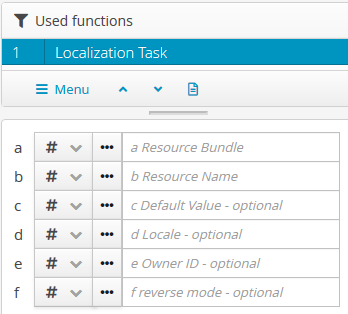
Parameters
Parameter | Description | Example | Notes |
|---|---|---|---|
a | Resource Bundle |
|
|
b | Resource Name |
|
NOTE For the "reverse search" (see parameter f), it is necessary to define the localization here for which a matching Resource Name is to be searched. |
c | Default Value (optional) | FORWARDER |
|
d | locale (optional) | de |
|
e | Owner ID (optional) | 52 |
|
f | reverse mode (optional) | true |
|
Examples
Example: Search for a localization.
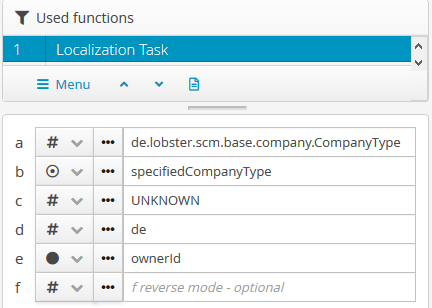
Here the German localization for a Company type specified in the target field
specifiedCompanyTypeis searched for.If the specified company type is unknown or no German localization exists for this company type, the default value
UNKNOWNis returned.If Company specific localization are applicable for the context of the company identified by the source field
ownerId, they will be considered if necessary.The "language" in the target field, for which the function is configured here, is therefore specific to the "owner" of the entity in the input data.
Example: "Reverse search" for a key value of a dynamic enumeration originating from a localization.
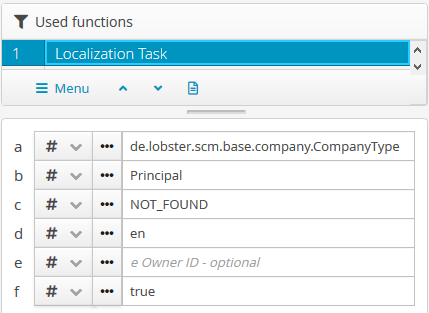
Based on an English localization "Principal", the corresponding Resource Name is determined among the localization entries for the Company type.
This is identical with the internal name of the value of the dynamic enumeration in question and in the concrete example is
AAL(German: "Auftraggeber").