See also: className (Class name)
Value resolver – Abstract
Purpose: This returns the class name of the object present as the input value in the form of a string.
Tooltip
Usage: The object to be evaluated must be available as an input value (reference object, if applicable). The value resolver returns the fully qualified class name of the Java class or – for selected object types in the client context – another class name. The fully qualified class name is occasionally used as a key value for references, e.g. also as a bundle name within the Localization. If the input value is "no value" (
$null), the return value is also "no value" ($null).NOTE The return value is often, but not without exceptions, identical to the string image for the "type hint" in the
entityClassvariable, which, however, can only be evaluated for a reference object and not for an input value.
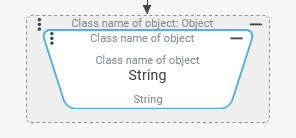
The Class name of object resolver returns the class name of the object available as an input value as a string.
The return value for the "class name" can depend on the execution context (client/server):
In the server context, the "class name" is the fully qualified class name of the specific Java class of the input value.
Although there is no direct reference to the server-side Java class in the client context (via JavaScript), the fully qualified class name of the Java class is also output there as the "class name", provided the object is not the value of a native JavaScript type (e.g.
Boolean,NumberorString).
If "no value" ($null) is the input value, "no value" ($null) is also returned as the "class name" instead of a class name and not an empty character string ("") or the text value "null’.
NOTE In many cases, the entityClass variable can also be used instead of the Class name of object resolver to determine the "class name" of an object. However, its string image often does not provide without exceptions (e.g. "check type hint on empty value", see Check type) the same string as the value resolver. However, the object to be evaluated must be available as a reference object (possibly in the context of an Execute with event action), whereas the Class name of object resolver takes the input value into account and can therefore be used much more flexibly – e.g. also within a value resolver chain.
Configuration
The Class name of object resolver does not use any parameters.
Example
A typical use for the Class name of object resolver is to access the Localization or Company specific localization.
For many classes, the system provides localization entries that use the fully qualified class name as the Bundle name.
Localizations for the "class name" can then be found by convention under the Resource name $name. In addition, a Resource name $pluralName may be provided for the plural.
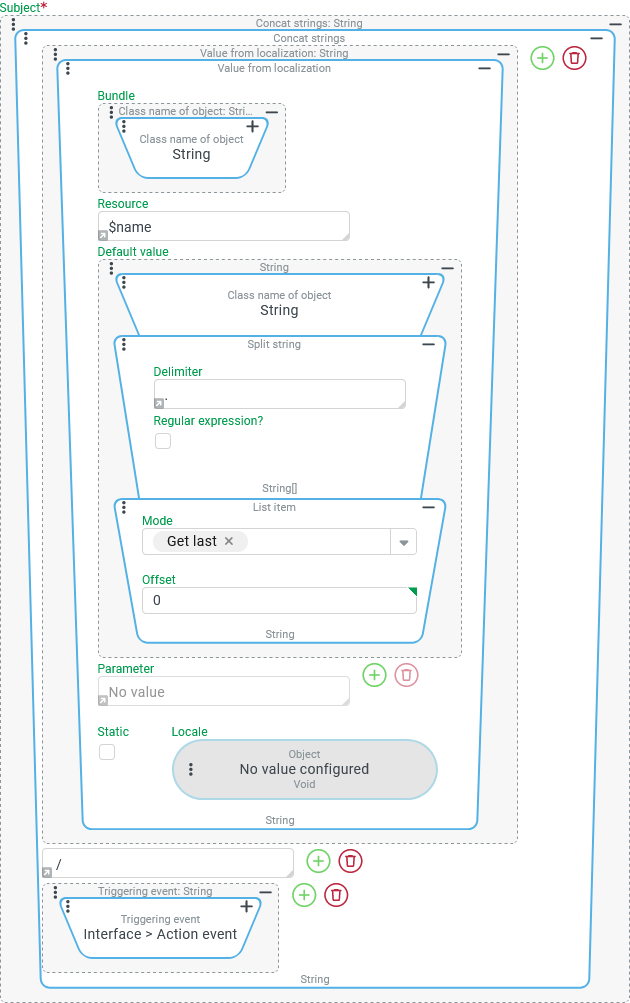
The Class name of object resolver can therefore be used in the context of a Value from localization resolver in order to use the (possibly) localized class name.
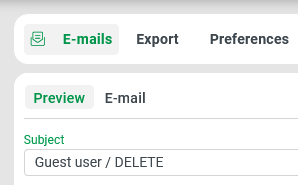
In the following example, when an entity of any type is created or deleted, an e-mail is to be sent in which the entity type is specified in the "Subject", taking into account a localization for the class name.
Runtime example:
Configuration:
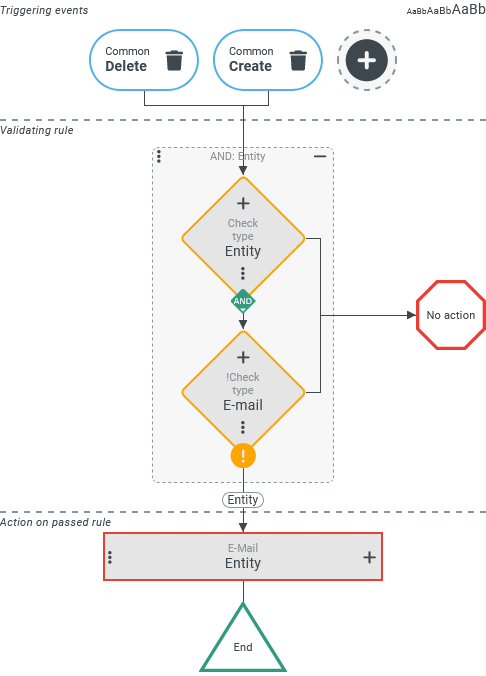
The screenshot on the right shows an overview of the configuration for event handling that reacts to the Triggering events "Delete" and "Create" (see Common action event). An AND junction of two instances of the Check type is configured here as the Validating rule:
A E-mail event action is provided as the only Action on passed rule. As no further event actions are available, all preparation steps for content and addressing of the e-mail within the configuration for this event action must be carried out either statically or via value configurations for designated parameters. |
|
For the context of this example, only the value configuration for the Subject, for which a text value is expected, is of interest from the numerous parameters for the E-mail event action. The screenshot on the right shows a value resolver chain through which the localization for the entity type is integrated via the Class name of object resolver in the context of a Concat strings value resolver:
|
|