See also: get document content (Integration function)
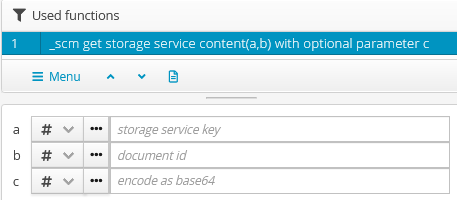
The get storage service content (Integration function) function returns the content of a document uploaded to Lobster Data Platform/Orchestration if it is registered with the storage service specified by parameter a (storage service key) under the key value defined by parameter b (document id).
Parameter
Description
a
Storage Service Key: Identifier for a storage service from Lobster Data Platform/Orchestration.
b
Key value (
document id) under which the document was registered by the service.c
With the value
truethe document content is returned as a Base64 string, otherwise binary data.
What is a Storage Service?
Lobster Data Platform/Orchestration manages uploaded files ("documents") depending on the context via one of the following "Storage Services"
Storage Service Key
Context
Entity in context
"Document" in context
Key value ("Document id")
Optional module?
mailAttachmentsE-mail created by the system
core:MailFile attachments
(
attachementEntry.content)Internal ID of the mail attachment
(
attachementEntry.id)No (always installed)
documentsDocument
doc:DocumentDocument content
(
documentContent)Internal ID of the document
(
id)Documents (
DOC)
signedByImagesTracking status entry
baseTS:TrackingStatusEntryRecorded signature (graphic file)(
signedByImage)Internal ID of the tracking status entry
(
id)Tracking status (
TS)NOTE The term "document" is used in this context as a generic term that can refer, among other things, to the Documents managed in the document module of Lobster Data Platform/Orchestration. For the access to such Documents, the function get document content (Integration function) can be used alternatively, for which the Storage Service Key
documentsis virtually "preset".
The function get storage service content (Integration function) returns the content of a document uploaded to Lobster Data Platform/Orchestration, if it is registered with the storage service specified by parameter a (storage service key) under the key value defined by parameter b (document id).
Depending on parameter c the document content is returned either binary (false/Standard) or Base64 encoded string.
NOTE
The document content is made available without consideration of role permissions, ownership and authorizations applicable for Lobster Data Platform/Orchestration, if the access is made by get storage service content (Integration function) function.
If no document with the
document idaddressed in parameter c exists at the time of the function call, the profile terminates with an error.
Parameter
Parameter | Description | Example | Note |
|---|---|---|---|
a | Storage Service Key: Identifier for a Storage Service from Lobster Data Platform/Orchestration. |
| The info box (above) lists the valid Storage Service Keys. |
b | Key value ( |
| The info box (above) indicates how the key value is defined per Storage Service. |
c | With the value true the document content is returned as Base64-string, otherwise binary data. |
| Base64 content can for example be used in XML documents to embed binary files as strings.The return of binary data returns the file content directly (like a download). |
Example
A profile forwards a certain file attachment from an e-mail generated by Lobster Data Platform/Orchestration to another system via a suitable reply path.
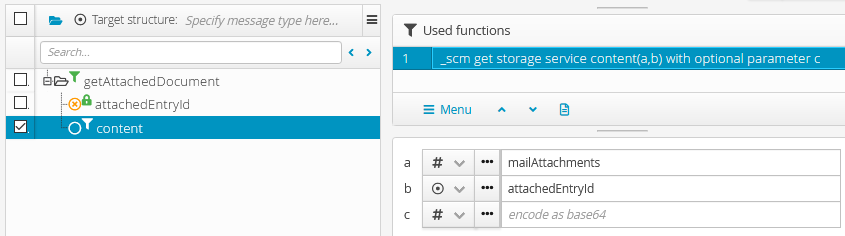
The attachedEntryId calculation field first determines the internal ID of the attachment to be accessed, e.g. via a Search or Tuple search defined with the SearchTask (Integration function) function for the core:Mail object.
NOTE As the symbol for the field indicates, a fixed value was stored here, since details for determining the ID are irrelevant for the example.
In the content field, which is crucial for the output in the reply path, the get storage service content (Integration function) function calls the content for the determined internal ID:
The relevant Storage Service for e-mail file attachments is specified in the parameter a by the Storage Service Key
mailAttachments.The value from the target field
attachedEntryIdis transferred to the parameter b asdocument id, i.e. the previously determined internal ID.The parameter c gets no assignment, as the file content should be returned directly ("binary" and not as Base64 code).