Event action – Abstract
Purpose: Creates an entity of the (SCEM) event type with the characteristics optionally definable by configuration. If the Incident type parameter specifies an Incident type, the event action triggers the specific event for that Incident type with the (SCEM) event entity as the input value. The (SCEM) event entity may contain a list of references to other entities called Affected Entities.
Tooltip
Usage: The execution of the event action does not require a reference object as long as no references to involved objects are stored. All parameters are optional. If no parameters are specified, the corresponding fields of the created incident entity remain empty.
Parameter: (all optional)
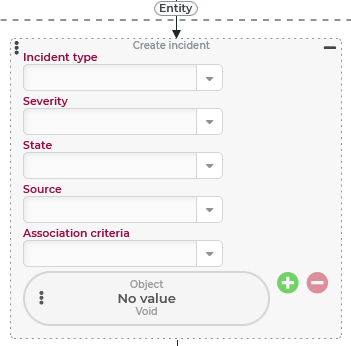
Incident type: Reference to an Incident type (and therefore a 'triggering event' for event handling).
Severity: Reference to a value from the dynamic enumeration Incident severity.
State: Reference to a value from the dynamic enumeration Incident status.
Source: Reference to a value from the dynamic enumeration Incident source.
Association criteria: Multiple selection of Association criteria for the created incident.
Affected Entity: Duplicated element with a value resolver for references to arbitrary entities.
Output:
(SCEM) incident entity is created with the parameterized characteristics.
If 'Incident type' is specified, the corresponding incident will be triggered.
WARNING Assignments for Affected Entities are saved only if the event action is performed with an (arbitrary) entity as the reference object.
The event action Create incident creates an entity of type '(SCEM) incident' (see SCEM Incident) with the optionally definable features per configuration.
If an Incident type is specified in the Incident type parameter, the event action triggers the specific event (see Incident type (Events)) for this Incident type with the incident entity as input value.
Configuration
The optional Incident type parameter defines an assignment to the corresponding 'Incident type' field (
incidentType) of the created incident based on the dynamic enumeration Incident type.The optional Severity parameter defines an assignment to the 'Severity' field (
incidentType) of the created incident based on the dynamic enumeration Incident severity.The optional State parameter defines an assignment to the 'State' field (
incidentType) of the created incident based on the dynamic enumeration Incident status.The optional Source parameter defines an assignment to the 'Source' field (
incidentSource) of the created incident based on the dynamic enumeration Incident source.The optional Association criteria parameter allows multiple selections of Association criteria for the created incident.
A Repeatable element optionally allows assignments that define 'Affected entities' (
affectedEntities) for the new incident. Via the symbols.svg) and
and .svg) such assignments can be added or deleted.
such assignments can be added or deleted.
CAUTION 'Affected Entities' are created successfully only if the event action is performed in the context of an entity. However, this entity does not have to be assigned as an 'Affected Entity'. If the event action Create incident is executed in the context of an event handling in which no entity exists as a reference object, then an entity must be defined as a reference object via the event action Execute with, so that the new 'Affected Entities' event is actually assigned.
Example
Impending delays for the delivery of Shipments are reported via a special portal. For this purpose, the portal lists Shipments created in Lobster Data Platform/Orchestration with relevant work states for selection. If a significant delay is announced for a shipment in the list, a behavior triggers an Custom action event, which passes a client object with various detailed data (including the internal ID of the shipment in a shipmentId field) via the variable formData. An SCEM incident is then triggered via event handling in order to log the incident and, if necessary, trigger further measures.
Configuration:
The event action Create incident is configured within the event handling as shown to the right:
NOTE For the affected objects, only a combination of ID ( |
|
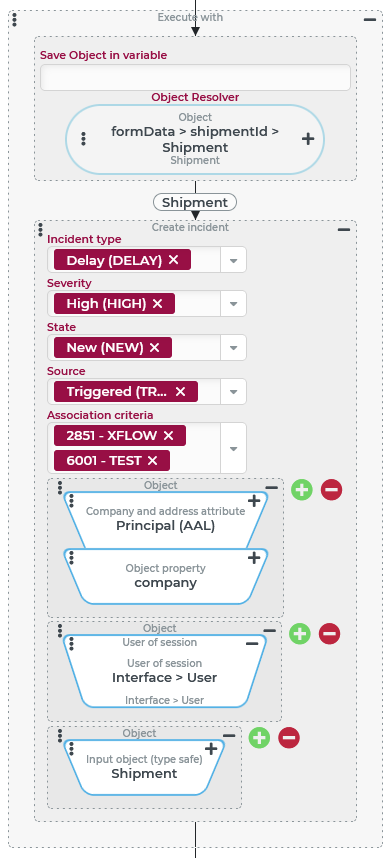
Any measures that go beyond just logging the incident can be regulated in subsequent actions within the same event handling. However, it is also possible to define event handling for the Incident type 'Delay' (see Incident type (Events)). The event action Create incident then triggers these automatically. The incident object and the references to the 'Affected Entities' are then available there as the data context.
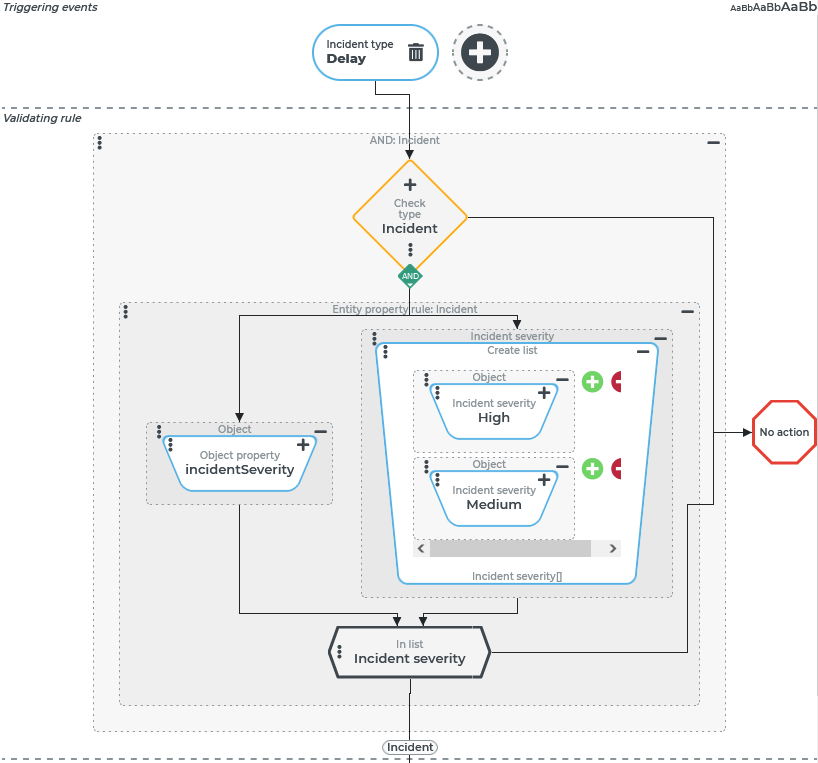
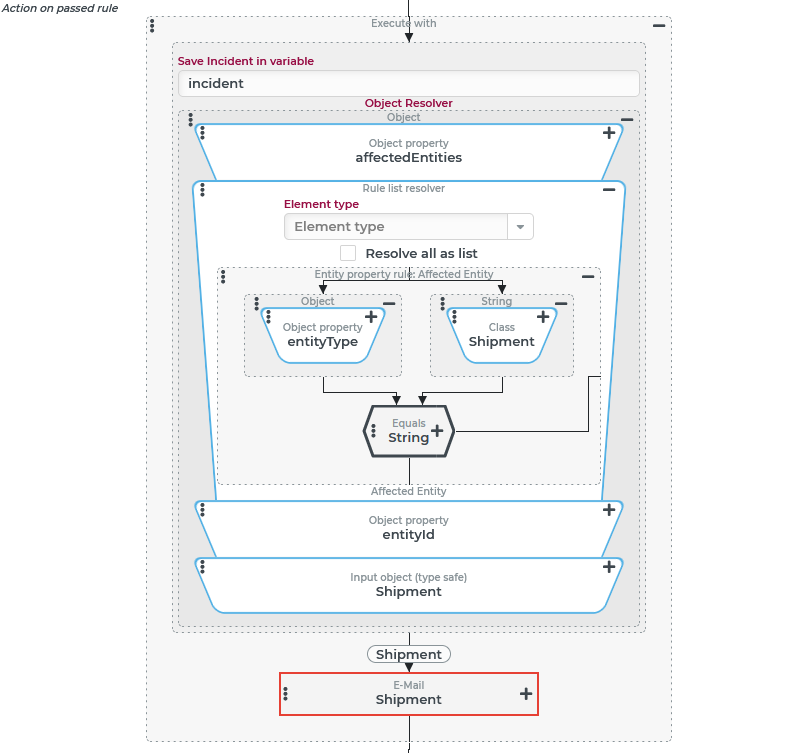
The configuration for an event handling (right) shows an example for the processing of incidents created for 'Delay':
The Actions on passed rule accesses the 'Affected entities' of the shipment type in the context of which a E-mail is triggered.
NOTE If data from the incident, which is not available in the context of the shipment, is used in the E-mail, the |
|
|